
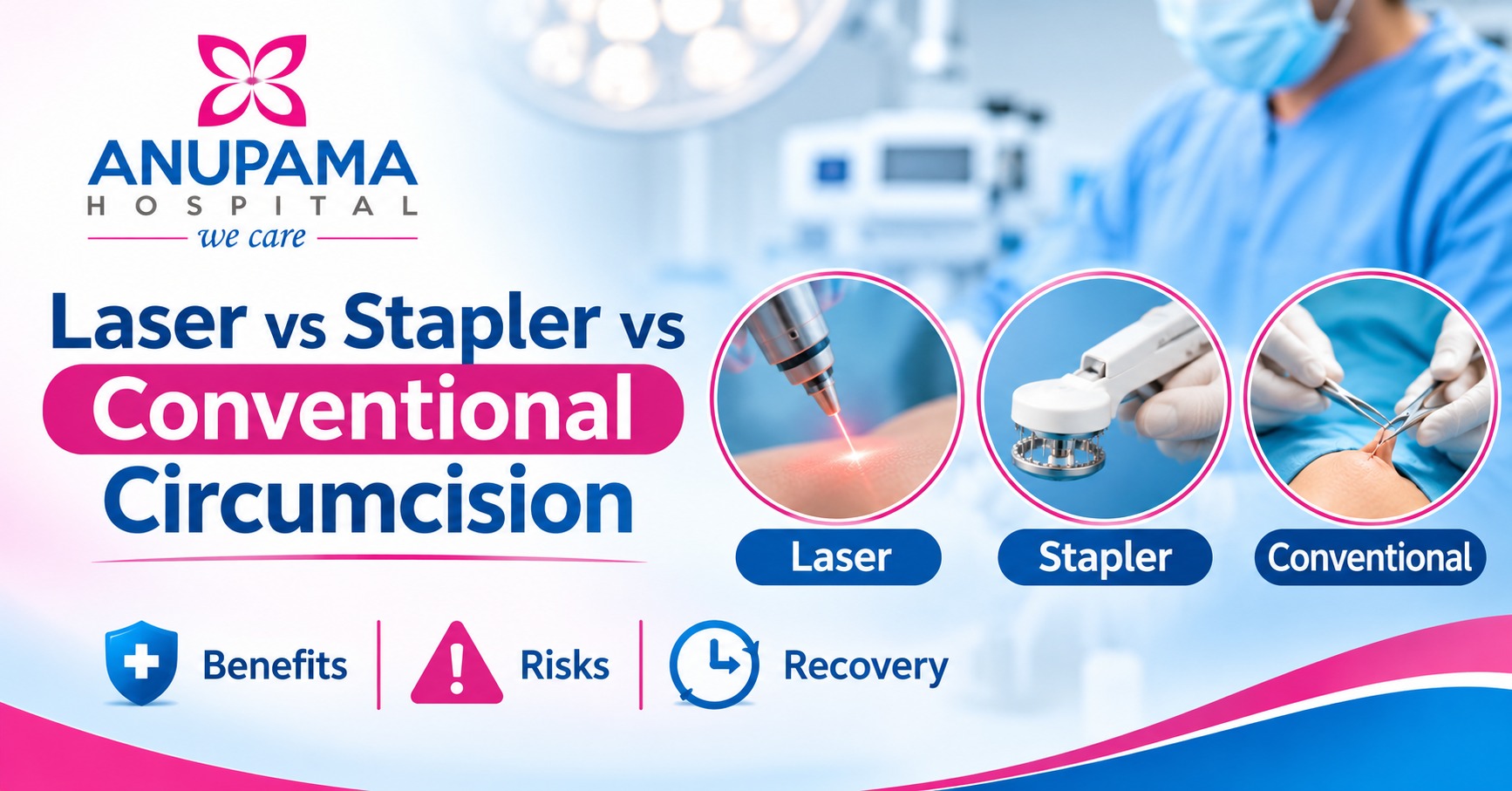
Types of Circumcision
Depending on the technique used for circumcision, there are various options for you to consider. Below we have summarised the pros, cons and considerations for each option.
Laser, Stapler or Conventional Circumcision
While all three types of circumcision remove the foreskin, the technique, wound care and patient considerations will differ between the options.
At Anupama Hospital, you can speak to qualified surgeons to determine which option would be most appropriate for you, based on your medical condition, age and individual requirements.
Types of Circumcision Explained
A circumcision is performed to remove the skin covering the head of the penis, called the foreskin. Circumcision may be recommended for:
- Phimosis (tight foreskin)
- Repeated infection of the glans (balanitis)
- Scar tissue
- Recurrent infection
Laser Circumcision
Laser circumcision uses laser energy to cut the foreskin away. Depending on the equipment and technique used, lasers can reduce bleeding within a wound by sealing small blood vessels.
Advantages
- Precise incisions can be made.
- In some cases reduced bleeding.
- Less manipulation of tissue.
- Good cosmetic appearance.
As this is still surgery, there is still the risk of swelling, pain, infection and wound healing issues. The result may also depend on the skill of the surgeon and the equipment used.
Not all patients may have pain-free or quick recoveries following laser circumcision.
Stapler Circumcision
The foreskin can be removed and the wound closed using a special circular disposable device. This device will typically close the wound with small staples.
Advantages
- Shorter operations.
- Circular cut.
- Controlled wound closure.
- Reduced bleeding.
Depending on the device used and advice given by your surgeon, you may need to wait for the staples to fall out. Swelling, pain, wound dehiscence and irritation caused by the staples may be experienced temporarily.
Stapler circumcision may be appropriate for some adult patients. It may not be appropriate for all types of foreskin issues.
Conventional Circumcision
Surgical instruments, such as scalpels and scissors, are used to remove the foreskin. Dissolvable stitches are used to close the wound.
Advantages
- Appropriate for a variety of anatomical presentations.
- Ability to manage abnormal changes in tissues.
- Can be flexible in cases of significant scarring.
- No requirement for specialist stapling devices.
This may be particularly helpful in cases of significant scarring, inflammation or anatomical abnormalities. It requires careful surgical incision and wound closure.
Differences Between Laser, Stapler & Conventional Circumcision
Below is a summary of the differences between each type of circumcision to help you ask relevant questions in your appointment.
Comparison | Laser | Stapler | Conventional |
Instrument | Laser | Circular stapler | Scalpel/Scissors |
Incision | Energy | Mechanical | Surgical |
Wound closure | Varies based on technique | Staples | Stitches |
Length of operation | Varies | Often short | Varies |
Blood loss | May be reduced | May be reduced | Controlled |
Considerations | Equipment and heat effects | Management of staples | Care of stitches |
Overall, no single method is best for everyone. Research has shown that depending on technique, patient factors, and skill of the surgeon, the length of the operation, pain, and complications may vary between different methods.
[PubMed Research Reference]
Best Circumcision for Adults
The best type of circumcision for adults will depend on your medical condition.
Factors to consider include:
- Severity of phimosis: If there is a significant amount of scarring, conventional circumcision may be a better option.
- Foreskin anatomy: Abnormal anatomy may mean a particular technique is more appropriate.
- Infection: If there is active inflammation/infection, this may need treating prior to planned surgery.
- Medical history: Conditions such as diabetes, bleeding disorders or certain medications may affect the surgery.
- Personal preferences: How quickly you want to recover, cosmetic appearance of the wound and price may be considered.
For example, if an adult patient presents with simple tightness of the foreskin, multiple options may be appropriate. However, if there is significant scarring, then a different surgical approach may be needed.
Ultimately, after a physical examination and discussion with your surgeon, you will be able to make a decision.
Recovery from Circumcision
Circumcision recovery time can vary based on the procedure and the individual.
Mild swelling, bruising, pain and sensitivity can occur. This usually improves over time.
Commonly, full recovery from a circumcision takes 4–6 weeks. However, recovery times can vary between patients. [NHS]
Ways to Have a Comfortable Recovery
- Follow the advice from your surgeon regarding aftercare.
- Keep the area clean and dry.
- Wear loose comfortable underwear.
- Take any prescribed medications.
- Avoid vigorous activity and heavy lifting until advised.
- Avoid sexual activity until the wound has fully healed, and it is approved by your surgeon.
If you are experiencing increasing pain, fever, ongoing bleeding, unusual discharge or difficulty urinating, please contact your doctor.
Risks of Circumcision
As all of these are surgical methods, all have some risk.
Risks of circumcision may include:
- Bleeding and bruising.
- Infection.
- Swelling and pain.
- Delayed wound healing.
- Wound dehiscence.
- Cosmetic issues and scarring.
- Changes in sensations.
Additional risks may occur with stapler circumcision methods. Care must be taken with laser circumcision methods to ensure correct thermal effects on tissues. Care must be taken with conventional circumcision surgeries to ensure good wound closure.
A Cochrane review found that devices may perform operations more quickly. However, evidence is unclear surrounding differences in complication rates. [Cochrane]
Why It Is Important to Be Assessed by a Doctor
Not all cases of tight foreskin (phimosis) may require a circumcision. In some cases, phimosis may improve with topical steroid treatments prescribed by a doctor and simple stretching. In other cases, particularly if there is significant scarring and/or ongoing symptoms, a circumcision may be required.
A specialist can investigate the cause of the problem. They can then discuss other options with you and the benefits and limitations of each type.
Circumcision Treatments at Anupama Hospital
At Anupama Hospital, we can consider conventional, laser and stapler circumcision.
Depending on your age, anatomy, medical history and clinical presentation, we can consider which treatment is most appropriate for you. We can also consider with you which type of anaesthetic to use, expected recovery time, complications and aftercare.
Choose the Right Circumcision Treatment with Expert Guidance
At Anupama Hospitals, our surgical team can assess your condition, discuss suitable procedures and guide you through the treatment and recovery process. To find out more about Circumcision Surgery in Hyderabad or Urology Services at Anupama Hospital, click below.
Book your consultation today! Contact Anupama Hospitals to discuss your circumcision treatment options and take the next step towards better health.